Quick Answer
Key signs include handling dispatch yourself, missing calls regularly, having no backup if your dispatcher is unavailable, using LimoAnywhere without a trained dispatcher, and being unable to take a day off without operational problems.
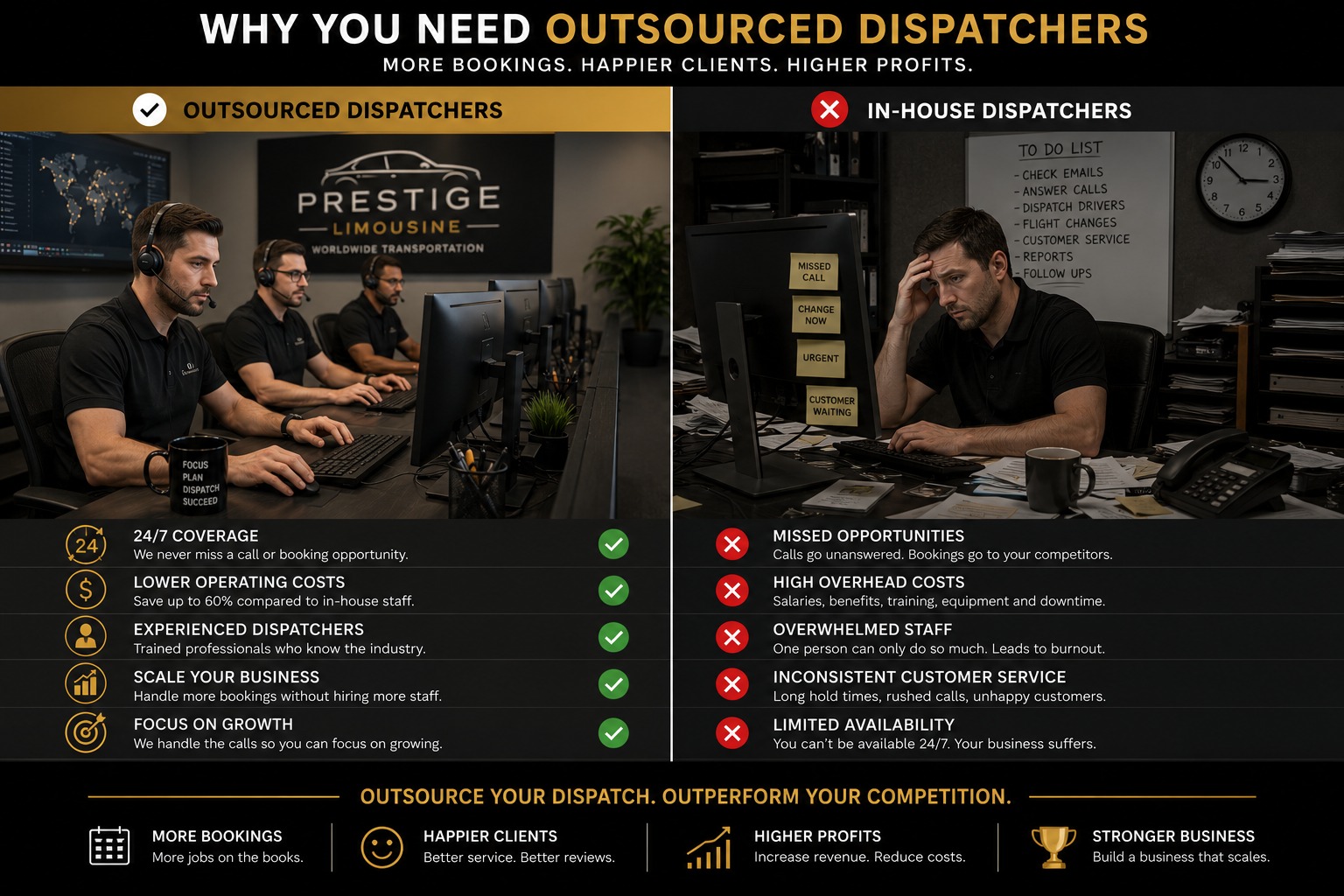
Most limo company owners do not decide to outsource dispatch because they read an article about it. They decide because something breaks — a missed booking, a driver coordination disaster, a week where they barely slept because they were on the phone at midnight three nights in a row.
The signs are usually visible long before the breaking point. Here are the five most common ones.
Sign 1: You are still the one handling dispatch
If you own a limo company and you are personally managing bookings, coordinating drivers and answering client calls during active trips, your business has a structural problem. Not because you are doing it badly — most limo company owners are good at it — but because you are doing it at all..
Owner-operated dispatch creates a ceiling. The company cannot grow past your personal bandwidth. You cannot be on a sales call, building a corporate account relationship, or looking at fleet expansion while you are simultaneously tracking a driver on the way to JFK and fielding a booking change from a client.
The moment your operation is large enough to have consistent daily dispatch activity, dispatch needs to be someone else’s job.
Sign 2: You are missing calls — and you know it
Voicemail is not a dispatch solution. A client calling to book a corporate transfer at 9pm on a Thursday who gets voicemail does not wait until the next morning. They call the next company on the list
If you have noticed missed calls in your call log, if clients have mentioned leaving messages that were not returned promptly, or if you have simply acknowledged to yourself that your phone coverage has gaps — you are losing bookings. The exact number is hard to calculate, but for a limo company with regular corporate or event clients, even two or three missed bookings per week at average trip values adds up to significant annual revenue loss.
A 24/7 limo call answering service eliminates this gap entirely.
Sign 3: Your dispatcher is a single point of failure
If you have one person handling dispatch — whether that is you, an in-house employee, or a part-time hire — your operation is one sick day away from a problem.
A dispatcher who calls in sick on a Saturday during wedding season is not just inconvenient. It is a potential operational crisis if you have multiple vehicles running and no one covering coordination. If your answer to “what happens if your dispatcher is unavailable?” is some version of “I step back in” or “we figure it out” — you have a reliability gap that will eventually become a client-facing problem.
Outsourced dispatch with a properly run team means backup coverage is always in place. You are never the contingency plan.
Sign 4: You are using LimoAnywhere but your dispatcher is not fully trained on it
LimoAnywhere is the operational backbone of most US limo companies. When someone is entering bookings incorrectly, missing farm-in and farm-out coordination, or not using the reporting functions properly, the errors show up in driver confusion, billing inconsistencies, and client miscommunication.
A dispatcher who is partially trained on LimoAnywhere — learning on the job, asking questions about features they should already know — is a liability, not an asset. If you have noticed booking errors, incorrect driver assignments or gaps in your LimoAnywhere data, the dispatcher’s software knowledge is almost certainly part of the problem.
This is exactly why LimoAnywhere-trained dispatchers are a non-negotiable standard, not a nice-to-have.
Sign 5: You cannot take a day off without the operation suffering
This is the clearest signal of all. If taking a Saturday off, going on holiday for a week, or simply being unavailable for a few hours causes real anxiety about what might go wrong in your operation — your dispatch is not under control.
A well-run limo company should be able to operate without the owner being on call. That requires dispatch that is handled reliably, consistently, and independently of whether you are available. If you are not there yet, outsourcing dispatch is one of the most direct routes to getting there
What to do next
If two or more of these signs describe your current situation, the next step is straightforward: a free consultation to look at what outsourced dispatch coverage would look like for your specific operation, your fleet size and your hours.
The cost is almost always lower than people expect. The impact on how the business runs is almost always larger.
Get a free consultation →
See what a dedicated dispatcher looks like →
Q: How do I know if my limo company needs outsourced dispatch?
A: If you are personally handling dispatch, missing after-hours calls, or have no backup when your dispatcher is unavailable, these are the clearest signs outsourcing is needed.
Q: What happens if I keep handling dispatch myself?
A: Owner-operated dispatch creates a growth ceiling — the business cannot scale past the owner’s personal bandwidth for managing bookings and driver coordination.
Q: How many missed calls indicate a real problem?
A: Even two to three missed bookings per week at average trip value can represent significant annual revenue loss, especially from corporate or repeat clients.
Q: Is one in-house dispatcher enough for a growing limo company?
A: A single dispatcher is a single point of failure. Sick days, time off or turnover all create coverage gaps without a backup system in place.